
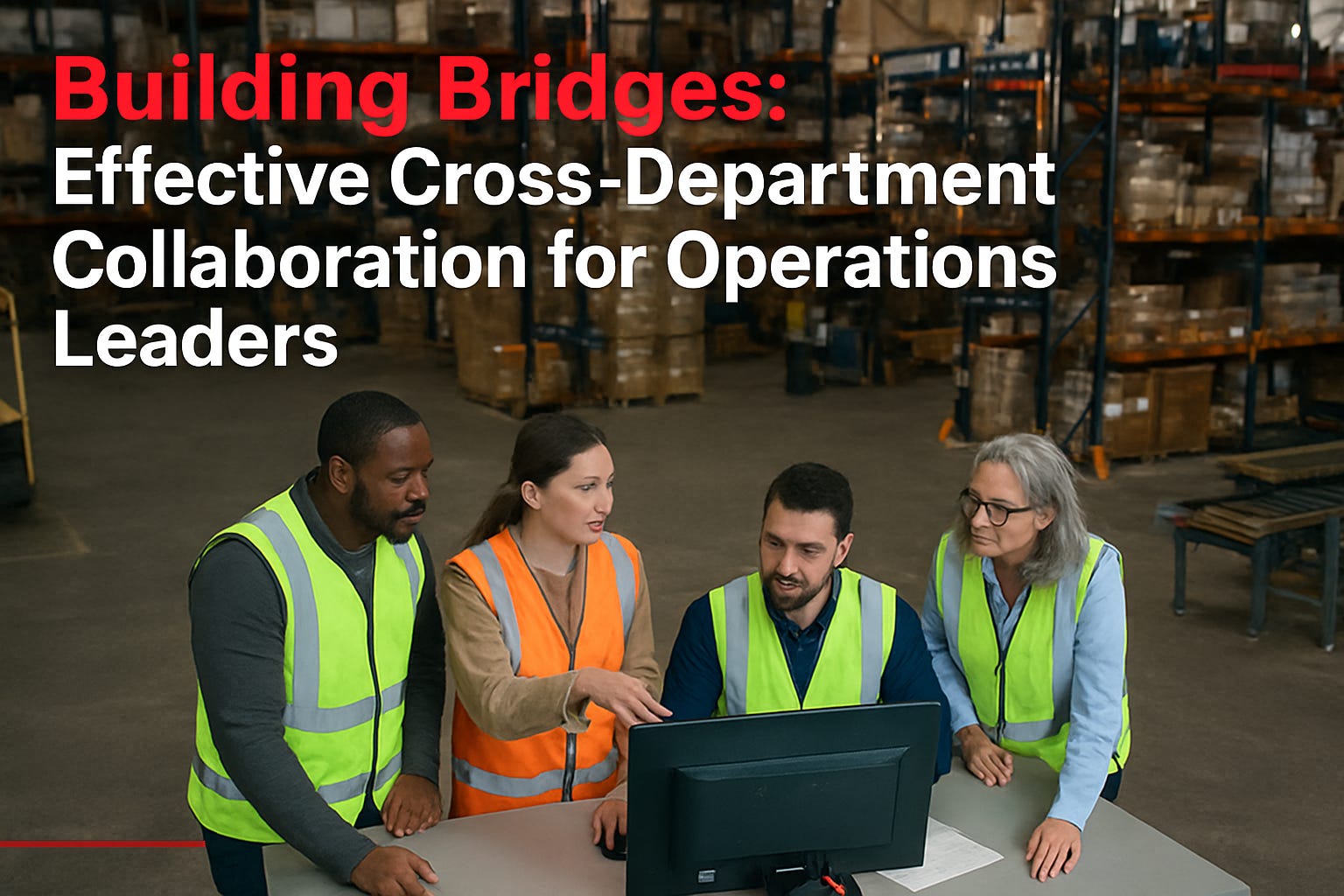
You’re standing in the middle of the warehouse floor when your radio crackles. It’s the shipping manager—again. They need extra people to load an urgent shipment, but you’ve already committed those people to the receiving department for a critical inbound delivery. Your safety manager is waiting to review a new procedure with you that will slow down your pack volume by 5%, just when you’re already behind on productivity targets.
You check your phone. The safety manager is now messaging: “Can we talk about implementation timeline?” Your operations manager wants an update on why yesterday’s numbers were soft.
And you haven’t even had coffee yet.
This is Tuesday. Just another Tuesday. And it’s only 9 AM.
I learned this lesson the hard way during my time managing operations at Amazon facilities processing thousands of packages daily. I could run an excellent outbound operation—my team’s metrics were solid, morale was high, and we consistently hit our targets. But in 2020 I was working on what was at that point the largest, most ambitious project of my career. I needed to coordinate a facility-wide process improvement that required buy-in from Inbound, Outbound, Safety, Quality, and Maintenance. That’s when I discovered that being a good manager wasn’t enough. I needed to become a bridge-builder.
This week’s article covers the practical strategies that helped me to eventually make this shift. Whether you’re coordinating with adjacent departments on daily operations or leading strategic initiatives that span multiple functions, these principles will help you build the collaborative relationships that advancing leaders need to succeed.
Why This Matters Now
Let me be frank: if you’re at the 3-5 year mark as a manager and still struggling with cross-functional work, that’s your ceiling. Your technical skills and operational expertise got you here, but your ability to orchestrate collaboration determines where you go next.
Here’s the pattern I’ve seen after years of working with hundreds of managers across dozens of Amazon facilities: The ones who advance fastest aren’t necessarily the best operators. They’re the ones who make collaboration look effortless. They’re the leaders other departments actually want to work with.
Your initiatives now require multi-department alignment. Your success depends on influencing people you don’t manage, in departments you don’t control, pursuing priorities that sometimes conflict with yours. As I discussed in my article on creating an operational vision, the best leaders understand how all the pieces fit together and actively work to strengthen those connections.
The cost of failing shows up everywhere. Your teams duplicate effort. Process improvements stall. Innovation opportunities slip away. And your team feels the friction of competing priorities without understanding why.
But when it works? Problems get solved faster. Innovation accelerates. Your influence expands. And senior leadership notices who can operate effectively across boundaries.
Understanding the Collaborative Landscape
Before you can build effective bridges, you need to map the terrain. Who are the key stakeholders? What pressures do they face? What metrics define their success?
When I moved into my Operations Manager role, I made a critical mistake: I assumed other department leaders understood my operational realities as well as I did. I’d send requests framed entirely around my needs—”I need more people for the shipping dock,” “Can you expedite this maintenance request,” “We need to adjust the safety procedure because it’s slowing us down.”
I couldn’t understand why I kept hitting walls. Then after our shift one day, I was walking through the parking lot with Jason and he asked me a simple question: “Do you know what keeps the transportation manager up at night?”
I didn’t. And that ignorance was killing my effectiveness.
So I did something that felt awkward at the time: I scheduled a 15 minute meeting with our transportation manager and asked her. Not about my current requests. Not about coordination issues. Just: “What’s hard about your job right now?”
Turns out, her team was having a lot of issues with on-time departures. She was getting phones calls from her senior leadership every time a truck left late. The network-level metrics made our site’s performance visible across five states. Every late truck wasn’t just our problem—it was her career problem.
Suddenly, every request I’d ever made to transportation looked different. Once I understood her world, I could finally speak her language. And that changed everything.
Understanding what each department values changes everything. Finance speaks ROI and cost avoidance. HR speaks retention and engagement. Safety speaks risk mitigation. Quality speaks defect reduction. Once you understand what they value, you can show them how helping you actually helps them.
The most common collaboration pitfall? Approaching every interaction with a “my department first” mindset. You frame requests around what you need, when you need it, and why it matters to your metrics. You’re essentially asking other departments to prioritize your success over theirs.
Want to know what works better? Find where your goals naturally align. This shift—from “what I need from them” to “where our success overlaps”—is the foundation of all effective collaboration.
Build Relationships Before You Need Them
The biggest mistake I made early in my career was treating relationships like tools I could pick up when I needed them. I’d reach out to peer managers when I had a problem, then disappear back into my operational bubble until the next crisis.
Treat people like tools, get treated like a tool. Shocking, right?
As I wrote about in my article on building trust through active listening, trust precedes collaboration. You can’t manufacture it in the moment you need it. But if you invest consistently in relationships before you need them, you build collaboration capital that compounds over time.
Here’s what actually works in operational environments:
First, invite peer managers to shadow your operation. Show them what your world looks like, what challenges your team faces, and what success looks like in your department. Then ask to shadow theirs. This mutual understanding creates empathy that transforms future interactions.
Second, schedule regular coffee conversations that have nothing to do with current projects. Ask about their challenges, celebrate their wins, and share your own experiences. These relationships become the foundation for everything else.
Third, offer your expertise when you can genuinely help. If you’ve implemented a process improvement that might benefit another department, share it freely. This generosity creates natural reciprocity.
Fourth, recognize other departments’ wins. When Transportation has a perfect on-time departure week, acknowledge it. When Quality drives down defect rates, celebrate it. This costs you nothing and builds goodwill everywhere.
Speak Their Language
Different departments don’t just have different priorities—they have different vocabularies, different ways of thinking about problems, and different frameworks for evaluating solutions. Learning to speak their language isn’t manipulation. It’s respect.
As I wrote about in my article on adaptive communication, the best leaders adjust how they communicate based on who they’re talking to. In cross-functional work, this adaptation becomes essential.
The translation framework: Start with their priority, not yours. Quantify impact in their metrics—”This saves $47K annually” beats “This helps retention.” Connect to their existing initiatives. Provide options, not demands—”Here are three approaches” invites collaboration; “We need to do this” invites resistance.
When you speak someone’s language, you’re demonstrating that you understand and value their world. And that understanding is the basis for all meaningful collaboration.
Manage Competing Priorities Transparently
Here’s an uncomfortable truth: Sometimes departments have genuinely competing priorities, and no amount of relationship-building or clever communication can eliminate that conflict.
Your safety manager needs you to implement a new procedure that will slow down your operation. Your boss needs you to increase productivity. Both priorities are legitimate. Both create value for the organization. And they directly conflict with each other.
Welcome to leadership at scale, where everyone wants different things at the same time, and somehow you’re supposed to make it all work. Good times.
Many people’s first instinct is to pretend the conflict doesn’t exist, to try quietly serving both masters, or to complain privately about one priority while publicly pursuing the other. All of these approaches make the problem worse.
Here’s what works better:
Acknowledge the conflict openly. Name the competing priorities without judgment. Quantify the trade-offs and make the decision impact visible to everyone involved. Escalate appropriately—some conflicts need your solution, others need senior leadership input. Document the decision so everyone understands what was decided and why. Then follow through and honor the prioritization decision made.
When you handle competing priorities transparently, you build a reputation as someone who faces reality honestly and works to find solutions rather than excuses.
Lead Collaborative Problem-Solving
When problems cross departmental boundaries, the natural tendency is to focus on fault and blame. Whose process failure created this issue? Which department should have caught this earlier? Who’s responsible for fixing it?
This blame-oriented approach might feel satisfying momentarily, but it’s terrible for actually solving problems.
Be the person who solves problems instead of pointing fingers. It’s really that simple.
As I covered in my operational problem-solving series, this matters even more when problems cross department lines. Gather diverse perspectives early. Define the problem neutrally, focusing on impact rather than fault. Brainstorm collaboratively. Test solutions together. Share ownership of results.
Here’s what happens when you consistently do this: You become known as someone who makes cross-functional work easier. Other leaders seek you out. Senior leadership notices who can operate effectively across boundaries. And your influence expands far beyond your direct authority.
Overcoming Common Obstacles
”I don’t have time for relationship building.” I hear this constantly from managers who then spend six hours a week in meetings that go nowhere because nobody trusts each other. Calculate the time cost of poor collaboration: hours dealing with miscommunication, working around conflicts, fixing preventable problems. For most operations leaders, poor collaboration costs 5-10 hours weekly. Investing 30 minutes per week in relationship building delivers massive ROI.
”Other departments don’t cooperate.” Before concluding others won’t cooperate, examine your own approach. Are you speaking their language or yours? Are you building relationships before you need them, or only reaching out when you have requests? Lead by example. One-sided collaboration that consistently adds value eventually becomes mutual.
”My boss doesn’t value cross-functional work.” Document collaboration wins. When a cross-functional initiative succeeds, capture the metrics your boss cares about: cost savings, productivity improvements, risk mitigation. Senior leaders care about results. Show the connection between collaboration and performance.
”We have too many competing priorities.” This is exactly why collaboration matters more, not less. When everyone is overwhelmed, coordinated prioritization becomes essential. Use collaboration to negotiate priorities transparently and create efficiency through coordination.
”I’m not naturally good at relationship building.” Collaboration is a learnable skill, not an innate trait. If you’re introverted or task-focused, adapt the tactics. Written communication instead of coffee conversations. Structured agendas for meetings. Starting with one or two key relationships. Progress over perfection.
The Bridge-Builder’s Advantage
Remember those competing labor requests from the opening? I solved them with a 10-minute conversation with both managers, using exactly these principles. It took a year of relationship building to make that 10-minute conversation work.
The leaders who thrive at this level aren’t the ones with perfect solutions to every competing priority. They’re the ones who’ve built strong enough bridges that when conflicts arise, everyone works together to find solutions.
After about five years in leadership, your success IS cross-functional work. Your value proposition shifts from execution to orchestration. Your reputation rests not just on your department’s metrics, but on your ability to make things work across organizational boundaries.
The competitive advantage of collaboration mastery compounds over time. Each relationship you invest in makes the next one easier. Each successful cross-functional initiative builds your reputation and expands your influence. Each problem you solve collaboratively strengthens the patterns that make future collaboration more natural.
I wish I’d understood this earlier in my leadership journey. I spent years trying to succeed through pure operational excellence in my own department, wondering why I hit ceilings that other leaders seemed to break through effortlessly. The difference wasn’t their technical skills or work ethic—it was their ability to build bridges and orchestrate across boundaries.
You now have the frameworks, strategies, and actions to develop this capability intentionally. The question isn’t whether cross-functional collaboration matters—it does, increasingly so as you advance. The question is whether you’ll invest deliberately in building this strategic capability, or let it develop accidentally over many years.
From Theory to Action
1. Map Your Collaboration Ecosystem. List every department you interact with regularly and document their primary metrics, current pressures, and where your goals align.
2. Schedule Three Relationship-Building Conversations. Pick three peer managers and schedule 30-minute informal conversations—explicitly not about current projects.
3. Translate One Current Request. Take a pending request involving another department and rewrite it using their language and priorities. Note the difference in response.
4. Create One Structured Collaboration Mechanism. Identify your highest-friction cross-functional interaction and design a simple structural solution. Propose a 30-day pilot.
5. Lead One Collaborative Problem-Solving Session. Convene stakeholders from all affected departments for a current problem. Use neutral framing focused on impact rather than fault.
6. Conduct Quarterly Collaboration Audits. Set a recurring reminder to review your cross-functional relationships every three months and adjust based on what you’re learning.
Cross-functional collaboration isn’t a soft skill—it’s a strategic capability that separates adequate operations leaders from exceptional ones. Start with one action this week.