
You get called into an unplanned meeting. You're there for forty-five minutes. When you come back, what has happened on the floor?
That question has two very different answers, and which one you get depends almost entirely on what you built before you walked out the door.
I know both versions firsthand. In my early years at Amazon, I came back from an unexpected absence one afternoon to find my packing team lead standing near the conveyor with a quality problem, waiting. She'd been standing there for nearly twenty minutes. Not because she didn't know what to do, she probably did. But nobody had ever told her whether that decision was hers to make, so she did what made sense to her: she waited for me. Behind her, a small backlog had formed. A decision that should have taken two minutes had been on hold for twenty because I was the only one who knew where the authority line was.
The second version came after I'd done the work to build something different. Peak season, a few years later—I got pulled into a meeting about a major customer escalation and was gone for close to an hour. When I walked back onto the floor, my team lead met me near the entrance and gave me a status update: equipment had gone down on the loading dock and was back up, a quality issue had been flagged and corrected, and he'd pulled two people from pack line six to help cover a staffing gap on the inbound side. Three things had happened. Zero radio calls.
That wasn't luck. And it wasn't that my team was suddenly more capable than the one from years earlier. The difference was in what I'd built around them.
In When to Step In and When to Step Back, I wrote about the judgment call on the floor—the moment you decide not to intervene when your instinct says to. In The Debrief That Builds Leaders, I covered what to do with those moments afterward. But both of those skills depend on something more foundational: a set of systems that function when you're not there to enforce them. Without that, stepping back is just absence. With it, stepping back becomes development.
This week’s post is about building those systems.
The Test You're Already Taking
Here's something worth sitting with: your team is already being tested on what they can handle without you. Every time you're in a meeting, doing a walk in a different area, at lunch, or dealing with something else, your floor is making decisions. The question isn't whether those decisions are being made. It's whether your team has what they need to make good ones.
Most managers find out the hard way that they haven't set this up right. The pile-ups, the escalations that could have been handled two hours earlier, the team lead who made a reasonable call but had no idea whether it was within her authority—these aren't signs of a weak team. They're signs of a team that was never set up to operate independently.
Accountability without oversight isn't magic. It's built from three things that have to work together: clear expectations, visible performance, and defined ownership. Each one sounds obvious. Each one is routinely done badly.
Presence-Based vs. Systems-Based Accountability
Presence-based accountability works like this: people perform because you're watching, because they might get asked, because the manager is somewhere nearby. It produces compliance in the short term and fragility in the long term. The moment you're unavailable, it starts to degrade.
Systems-based accountability works differently. People know what's expected. They can see how they're performing against those expectations without asking anyone. And there's always a named person responsible — whether you're there or not.
Presence-based accountability produces compliance. Systems-based accountability produces ownership.
The shift from one to the other is less about management philosophy and more about three concrete things you either build or don't. Let's take them in order.
Vague Instructions Need You. Specific Ones Don't.
The most common accountability failure I see isn't that managers don't set expectations—it's that the expectations they set aren't specific enough to mean anything without interpretation.
"Keep quality up." "Make sure the line moves." "Handle problems that come up." These aren't expectations. They're intentions. And they need your presence to translate into behavior, because the moment a gray-area situation arises, your team lead has no way to know whether it falls inside "keep quality up" or outside it. So she calls you. Or she waits.
Expectations that work without you need to answer three questions before you leave the floor:
What does good look like, specifically? Not "hit your targets." What number, by what time, measured how? Not "address quality issues." Which issues get held, which get flagged, which get released with documentation? The more specific you are, the less your team needs to find you to make a call.
Where does her authority end? This is the piece most managers skip. Your team lead needs to know not just what to do in the standard case, but what's hers to decide and what isn't. What can she handle on her own? What needs a call to you? What gets escalated even if you're unreachable? These boundaries aren't about distrust, they're about confidence. A team lead who knows exactly where her authority ends can act within it without hesitation. One who doesn't will always hedge.
What's the default when something doesn't fit the standard? Edge cases are where things break down. Build in a fallback: when in doubt, here's what you do, here's who you contact, here's what gets documented. A clear default for ambiguous situations is worth more than a detailed procedure for normal ones.
The best place to work through all three is your one-on-one meetings. Not as a policy review, but as a conversation: "Walk me through what you'd do if X happened while I was in a meeting." The gaps in her answer are your development targets.
When the Floor Can See Itself
The second way accountability breaks down is invisible performance—a floor where only the manager knows how things are trending, which means all the information flows in one direction: up to you.
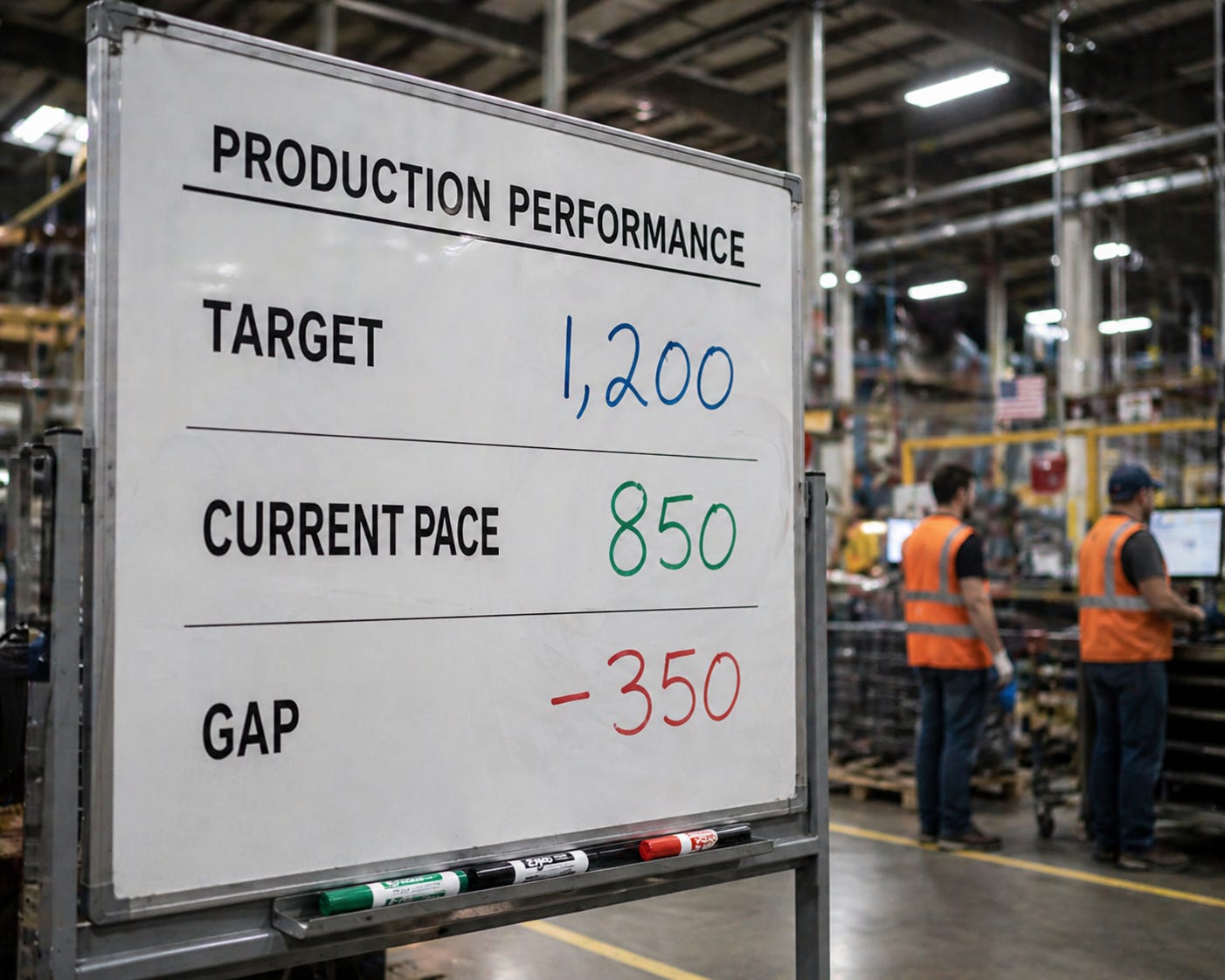
Early in my time as an Area Manager, I watched a senior ops manager do something that stuck with me. At the start of every shift, he took a whiteboard and wrote three numbers: the target, where the floor currently sat, and the gap. He updated it every hour. He didn't need to chase people down for status. He didn't need to be standing at every station. The board told the story, and his team could see it as clearly as he could.
That visibility changed something. When the number slipped, everyone saw it at the same time. The conversation about why became a team conversation, not a manager-asking-associate conversation. Problems surfaced faster because people weren't waiting to be asked; they were already looking at the same information and talking about it themselves.
Toyota understood this principle at a fundamental level. In the 1950s, they introduced the Andon cord, a physical cord running the length of the assembly line that any worker could pull the moment they spotted a defect or a problem. Not a supervisor. The worker closest to the work. Accountability was wired directly into the line rather than residing with whoever happened to be walking past.
The results were counterintuitive. Stopping the line more often led to better overall output, not worse, because problems got caught and corrected at their source rather than compounding downstream. Toyota's quality edge didn't come from more attentive supervisors. It came from designing a production system where the people doing the work could see problems in real time and act on them immediately.
That's the same problem you're solving, scaled down to your floor. You can't be watching every zone every minute. So the question is: can the people working those zones see what's happening without waiting for you to notice first? A whiteboard updated hourly, a simple metric visible at the relevant stations, a color-coded status board anyone can read in thirty seconds, these all serve the same function. Not surveillance. Shared awareness. When everyone sees the same picture, accountability stops requiring a manager in the room to function.
Named, Not Assumed
Clear expectations and visible performance are two-thirds of the equation. The third piece is ownership, and it's the one that most often gets left to chance.
Even with specific expectations and fully visible performance, things fall apart when nobody is clearly responsible. Shared responsibility without a named person becomes no responsibility. "Someone should deal with that" is the sentence that explains most of the problems waiting for you when you walk back in from a meeting.
What makes it stick is naming someone: for every significant responsibility on your floor, there is always a specific person who owns it during a given shift. Not "the team." Not "whoever's around." A person, named before the shift starts, who knows they're the point of contact if something happens in that area.
This is different from job assignments. It's accountability assignments. Your team lead at pack isn't just working pack — she's accountable for pack. If there's a quality issue, a staffing gap, or an equipment problem in that zone, it's her responsibility to address it or escalate it. She doesn't wait for you. She acts, and then she brings you the outcome.
Building this into your pre-shift routine is the most practical way to make it stick. Before the shift, five minutes: who owns what today, what are the expectations for each zone, what's the escalation path if something falls outside normal bounds. It sounds like overhead. It pays for itself the first time you get pulled out of the building unexpectedly and the floor handles it before you get back.
The Peer Accountability Problem
One thing worth addressing directly: as you build these systems, you'll notice something. When performance is visible and ownership is clear, team members start noticing when their peers aren't pulling their weight. This can go two ways.
Done well, it becomes the kind of peer accountability that makes teams genuinely high-performing—people holding each other to shared standards because they understand that one person's lag creates problems for everyone else. Done badly, it becomes a watching culture where people tattle on each other and trust erodes.
The difference is almost entirely in how you respond when someone brings you information about a peer. If you treat those observations as complaint-filing and act immediately on what you hear, you've incentivized tattling. If you treat them as data points to investigate and validate on your own, you build a culture where people feel responsible for outcomes without becoming each other's monitors.
The framing that works best, in my experience, is collective ownership: we're all accountable for this shift, not just for our individual zones. When people see themselves as co-owners of a shared outcome rather than guardians of their own performance, peer accountability starts to feel supportive rather than punitive. That shift in framing is one of the things I'll dig into in the next article in this series — because it's one of the main ways team culture actually forms, quietly and without anyone announcing it.
Summary
Accountability without constant oversight isn't about trust, or letting go, or any of the other things leadership books tend to make it about. It's built from three specific things: expectations specific enough that your team lead doesn't need you to interpret them, performance visible enough that nobody has to ask how the shift is going, and ownership clear enough that someone is always responsible whether you're there or not.
When those three things are in place, your absence stops being a vulnerability. It becomes something closer to a routine—a forty-five-minute meeting, a trip to a different building, a day of training—that your floor handles the way it handles everything else: without waiting for you.
When accountability is built into the work itself, your presence becomes a choice rather than a requirement.
From Theory to Action
1. Run the absence audit. Think about the last time you were unexpectedly pulled away from your floor for thirty minutes or more. What piled up? What got handled? What got decided wrong? That picture tells you exactly where your systems are weakest. Start there, not with the parts that are already working.
2. Take your three most important expectations and make them specific enough to survive without you. Write them down. If you can't define what "good" looks like in two sentences—the number, the threshold, the line—you don't have an expectation yet. You have a hope.
3. Have the authority conversation before something forces it. This week, sit down with each team lead and go through it out loud: what's hers to decide, what needs a flag to you, what gets escalated even if you're unreachable. Write it down somewhere both of you can see it. The conversation itself is half the value—it surfaces the gray areas you didn't know existed until you said them out loud.
4. Pick one thing to make visible on your floor and put it up this week. Not a dashboard. One number—your most important shift metric—somewhere the whole team can see it without asking. A whiteboard updated hourly is enough to start. Build the habit before you build the system.
5. Before your next shift, name the person responsible for each zone. "Michael owns sort today, which means if something goes sideways over there, he's the first call, not me." Say it in the pre-shift, so everyone hears it including him. That distinction, stated clearly, changes how people carry themselves through a shift.
6. Test your systems on purpose. Once things are taking shape, deliberately create a thirty-minute window where you're genuinely unavailable: a floor walk in a different part of the building, a meeting you actually attend instead of monitoring your radio from. Then debrief with your team leads when you're back. Use the same questions from last week's debrief framework: what did you see, what options were you weighing, what would you do differently? What they needed you for that shift tells you exactly what to work on next.
7. Watch for the moment your team stops routing problems through you. Peer-to-peer problem solving, two team leads working something out between themselves before it ever reaches your radio, is the clearest sign that your systems are doing what they're supposed to. When you see it, say something. Name it. People build more of what they know you've noticed.
This is the third post in the current series, building on When to Step In and When to Step Back and The Debrief That Builds Leaders.
Next week: The Culture You're Building Without Knowing It — how the daily behaviors in this series add up to something larger than any individual practice.